
It's the second week of December, and your class has stopped listening. Their heads are already on holiday. So use it.
Christmas words are the one word set students actually want to learn. Below you'll find 100 of them, sorted by level from A1 nouns to B2 idioms, plus three games that beat another word search. The last game, a five-letter Christmas Wordle, is the sleeper hit: almost no prep, and it works from A2 to C1.
The short answer: the most useful Christmas words for English learners are Christmas, Santa Claus, present, tree, decorate, wrap, and merry. Start A1 students with 20 simple, everyday words, add verbs and adjectives at A2 to B1, and save idioms like "Christmas came early" for B2.
20 Christmas words every A1 student can learn this week
Start with simple, everyday words. Five words per theme is about what an A1 class can hold in one lesson.
- People and animals: Santa Claus, elf, angel, reindeer, snowman
- Things on the tree and around it: Christmas tree, star, bell, candle, stocking
- Weather and time: snow, snowflake, December, holiday, Christmas
- Gifts and fun: present, gift, card, party, sleigh
Here's the catch: "present" is a trap word. Your students may already know it as "now," as in the present tense. Teach both meanings side by side, and say the noun out loud: PRE-sent, stress on the first part.
The verb, pre-SENT, can wait until B1.
One more tip. Teach "gift" and "present" together. They mean the same thing, and students love finding a free synonym.
Christmas decoration words (A2): baubles, tinsel, and the US/UK split
Decorations are where British and American English start to split. Pick one version for your class and mention the other once.
- ornament (US) / bauble (UK): a shiny ball you hang on the tree
- tinsel: long, shiny strips that sparkle
- wreath: a ring of leaves you hang on the door
- garland: a long rope of leaves or paper
- fairy lights (UK) / string lights (US): small lights on a wire
- holly: a plant with sharp leaves and red berries
- ribbon: a thin strip of cloth for presents
- bow: a ribbon tied in a pretty shape
- wrapping paper: colored paper for covering gifts
- snow globe: a glass ball with snow inside
- nutcracker: a wooden soldier figure with a moving jaw, made to crack nuts
- poinsettia: a plant with big red leaves
- pine cone: the hard, brown seed case of a pine tree
- icicle: a long, thin piece of ice
Watch out for "bow." On a present, it rhymes with "go." When you bend to say thank you, it rhymes with "cow." Write both on the board and let students guess which is which.
For a full lesson built on these words, try the Christmas decorations and holiday vocabulary lesson. It pairs decoration words with colors and style.

Christmas food and drink words (A2): the mince pie has no meat
Food words stick fast. Students remember what they'd like to eat.
- turkey: the big roast bird for Christmas dinner
- stuffing: bread and herbs cooked inside the turkey
- cranberry sauce: a sweet red sauce
- roast potatoes: potatoes cooked in the oven
- gingerbread: a sweet cookie flavored with ginger, often shaped like a person
- candy cane: a striped candy shaped like a hook
- mince pie: a small pie full of sweet dried fruit
- Christmas pudding: a dark, rich pudding full of dried fruit. It's steamed and served hot in the UK. British "pudding" isn't the soft American kind.
- fruitcake: a cake full of dried fruit and nuts
- eggnog: a creamy drink made with eggs and milk
- hot chocolate: a warm chocolate drink
- chestnuts: nuts you roast over a fire
Now the surprise. A mince pie has no meat in it, even though "mince" means chopped meat. Hundreds of years ago it did.
Today it's mostly fruit, sugar and spice. Some recipes still use suet, a kind of beef fat, so check the label if your students don't eat beef.
Bonus word: after dinner, people say "I'm stuffed." It means very full, like the turkey.
Christmas verbs (A2–B1): wrap, hang, plus two phrasal verbs
Nouns name the season. Verbs let students talk about it.
- decorate: make a place look pretty
- wrap / unwrap: cover a gift in paper, then open it
- hang: put something up so it's held at the top, like a stocking on a hook
- bake: cook in an oven
- celebrate: do something special for a happy day
- exchange: give one thing and get another back
- light: start a candle burning
- visit: go to see family or friends
- put up: place the tree or lights in the room
- take down: remove the decorations in January
- wish: say you hope good things happen to someone, as in "I wish you a merry Christmas"
That's 12 words, counting "unwrap." Two of them hide a trap: hang and light are irregular. "We hung the stockings and lit the candles" is a perfect past-tense sentence for December.
The "w" in "wrap" is silent. Say it like "rap." Expect at least one student to write "rap the presents" in a story, and enjoy it.
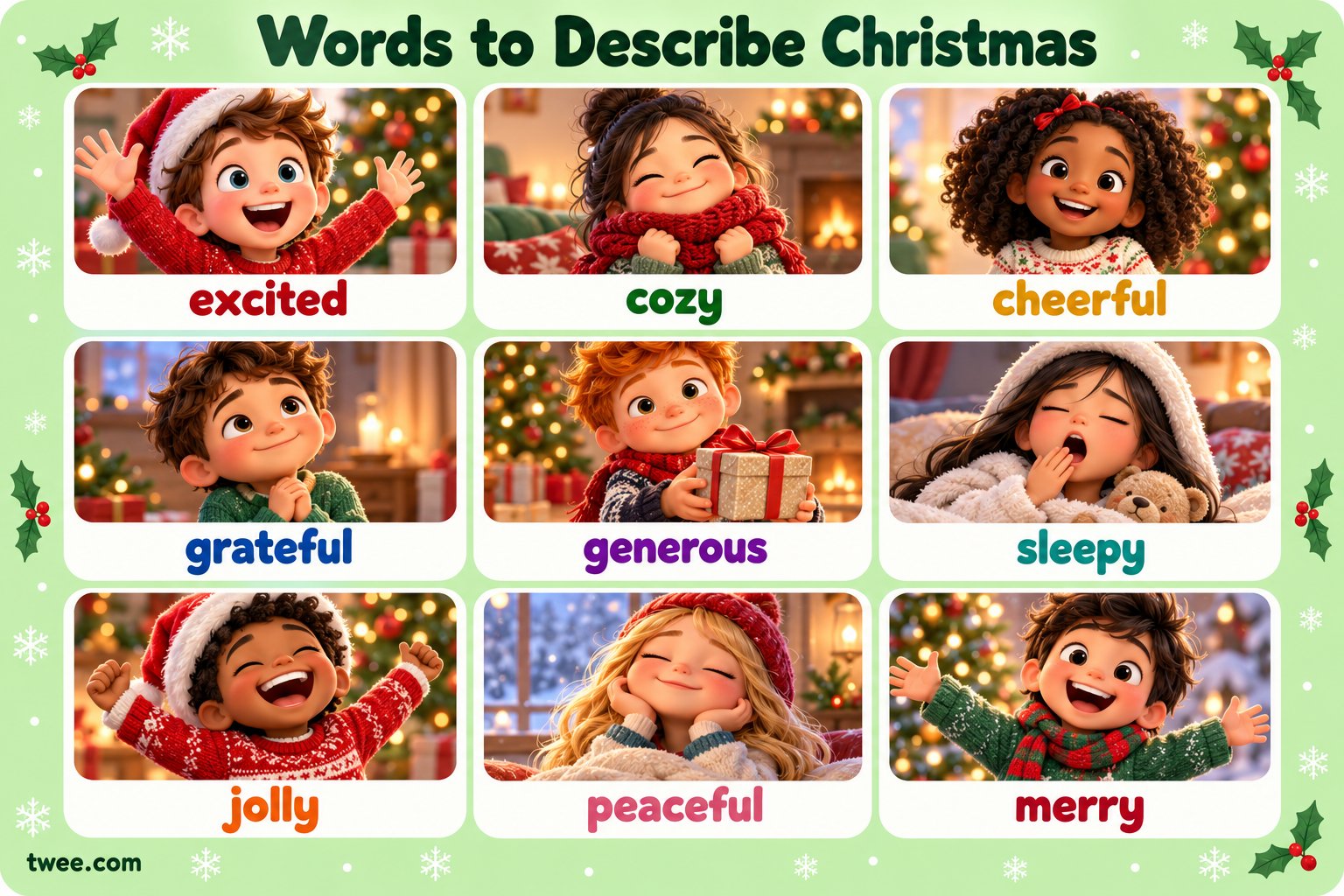
Christmas adjectives that go beyond "nice" (B1)
Ask a B1 class to describe Christmas and you'll get "nice" five times. These 15 words fix that.
- merry: happy and full of fun
- jolly: cheerful and friendly, like Santa
- festive: full of holiday feeling
- cozy: warm and comfortable (UK: cosy)
- cheerful: happy and bright
- magical: wonderful, as if by magic
- sparkly: shining with small points of light
- frosty: very cold, with ice on things
- snowy: covered in snow
- generous: happy to give to others
- grateful: thankful for what you have
- excited: very happy about something coming soon
- sleepy: tired and ready to sleep (like after Christmas dinner)
- peaceful: quiet and calm
- homemade: made at home, not bought
Here's what most word lists skip. "Merry" rarely appears outside fixed phrases like "Merry Christmas" and "the more the merrier."
A student who writes "my teacher is very merry" sounds odd. In British English, "merry" can even mean slightly drunk.
Also, "Happy Christmas" is not a mistake. It's common in the UK.
Tradition words and another word for Christmas (B1–B2)
Not every student celebrates Christmas, and that's fine. Teach these as culture words, the same way you'd teach "Diwali" or "Thanksgiving." Nobody needs to believe in Santa to spell "reindeer."
- Christmas Eve: the evening of December 24
- Christmas Day: December 25
- Boxing Day: December 26, a holiday in the UK, Canada, Australia and New Zealand
- Advent calendar: a calendar with a small door for each day of December up to Christmas
- carol: a Christmas song
- nativity: the story of Jesus being born
- mistletoe: a plant people kiss under
- Secret Santa: a game where everyone draws a name and secretly buys that person a gift
- Xmas: a short way to write Christmas
- Noel: an old word for Christmas, seen on cards
- Yule and Yuletide: old words for the Christmas season
- the holidays: the whole period from Christmas to New Year
- the festive season: the same thing, a bit more formal
Boxing Day has nothing to do with boxing. It probably comes from the boxes of gifts once given to workers. And the X in "Xmas" is the Greek letter chi, the first letter of "Christ," so it isn't disrespectful.
For the bigger picture, the Christmas around the world lesson shows how these traditions change from country to country.
12 Christmas idioms and phrases for B2 students
Idioms are where B2 students start to sound local. Most of these work outside December, too.
- all my Christmases have come at once: lots of good things happened together
- like turkeys voting for Christmas: choosing something that will hurt you (UK)
- Christmas came early: a great surprise arrived before you expected it
- lit up like a Christmas tree: covered in bright lights, like a car dashboard full of warning lights
- the gift that keeps on giving: something that helps for a long time (often said as a joke)
- stocking stuffer (US) / stocking filler (UK): a small, cheap gift
- a Scrooge: a person who hates spending money
- a Grinch: a person who ruins other people's fun
- 'tis the season: said when something happens because it's Christmas time
- a white Christmas: a Christmas with snow on the ground
- Christmas comes but once a year: enjoy it, because it's rare
- home for the holidays: back with family for Christmas
"Like turkeys voting for Christmas" is the crowd favorite. British news uses it about politics all the time. Ask students to invent their own version for school: "like students voting for more homework."
Want more? The winter idioms lesson adds cold-weather phrases like "break the ice."
Mystery stocking: teach Christmas words by touch (A1–A2)
Students can't see the object, so they have to describe it.
Level: A1–A2 · Time: 10 min · Prep: 5 min (one sock, eight small objects)
- Put eight objects in a stocking or sock: a bell, a candle, a ribbon, a pine cone, a star, a candy cane, a card, and a toy reindeer.
- One student puts a hand in without looking.
- They describe what they feel: "It's small. It's hard. It's cold."
- The class guesses. Whoever guesses correctly takes the next turn.
Expect someone to call the pine cone "a wooden Christmas potato." Everyone will remember "pine cone" after that.
The twist for B1: ban the word "small." Students must use "It's made of..." and "You use it to..." instead. With more than 20 students, run two stockings at once, or half the class waits too long.
The Secret Santa dialogue: Christmas vocabulary in real talk (A2–B1)
Word lists teach words. A dialogue teaches what to do with them.
Level: A2–B1 · Time: 15 min · Prep: none (use the script below)
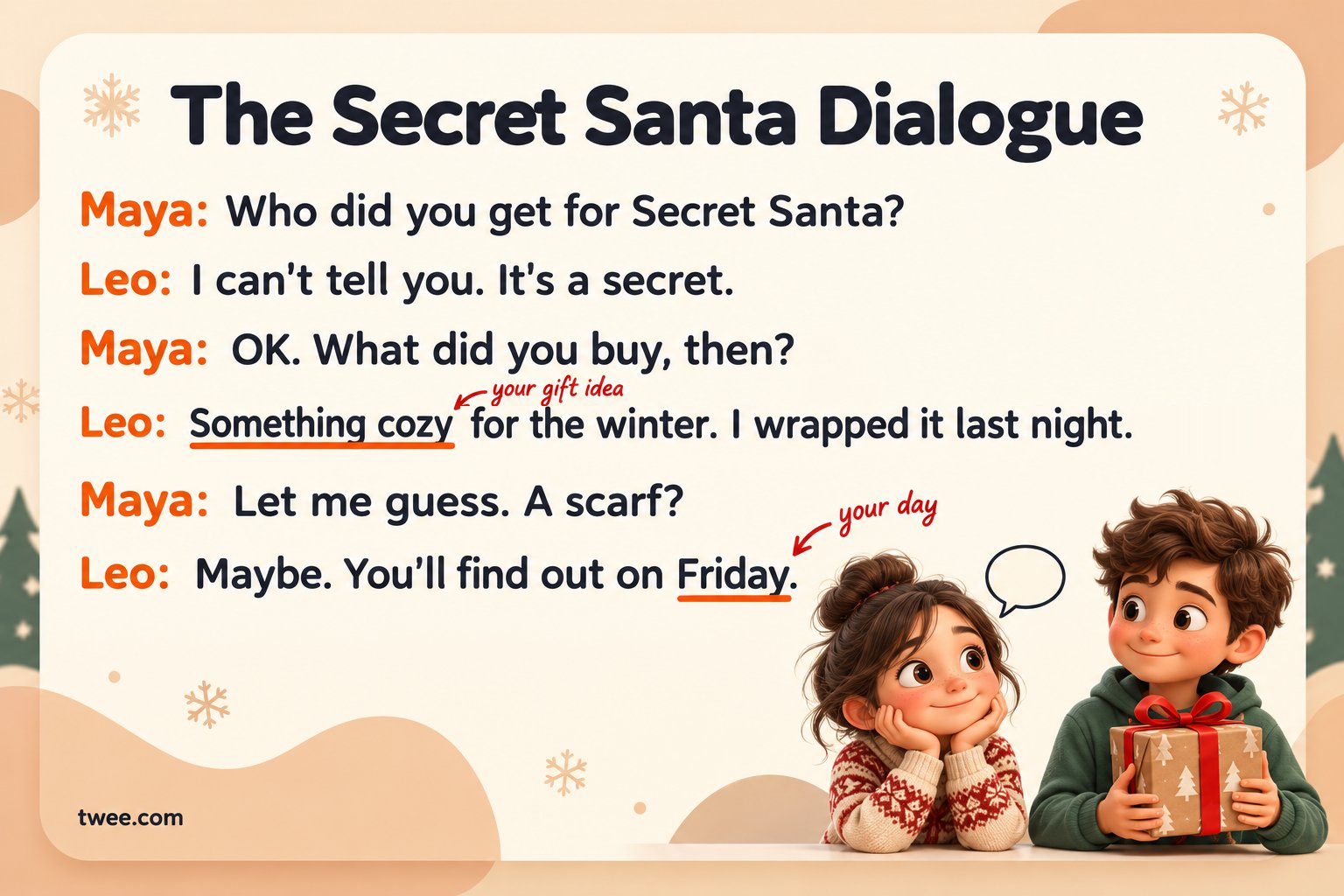
Maya: Who did you get for Secret Santa?
Leo: I can't tell you. It's a secret.
Maya: OK. What did you buy, then?
Leo: Something cozy for the winter. I wrapped it last night.
Maya: Let me guess. A scarf?
Leo: Maybe. You'll find out on Friday.
- Read the dialogue in pairs, once each way.
- Swap the gift idea and the day, and change Maya's guess to match.
- Perform it for another pair without the card.
The twist: some students don't do gifts, for money or other reasons. Run a "Secret Compliment" version. Each student draws a name and writes one kind sentence about that person, using an adjective from the B1 list.
Need a version for a different level or a different scene? Type "Secret Santa, A2, two friends, 6 lines" into Twee's dialogue creator and you get a fresh script in seconds.
Christmas Wordle with five-letter words: the game they'll ask for again
This is the sleeper hit from the intro. No printing, no cards, just a board.
Level: A2–C1 · Time: 10 min · Prep: 2 min (pick a word)
- Choose a secret five-letter Christmas word and draw five blanks.
- Teams take turns guessing any real five-letter English word.
- Circle letters in the right place. Underline letters that are in the word but in the wrong place.
- Six guesses in total. The team that solves it writes the next secret word on a slip of paper, spelled correctly, and hands it to you.
Word bank: carol, merry, jolly, elves, angel, gifts, frost, candy, cocoa, bells, santa, feast, cheer, peace, snowy, holly.
Why it works: the winning team has to spell its own word correctly. Spelling practice, disguised as a reward. C1 classes can play with six-letter words like "sleigh" and "wreath."
Steal these, adapt freely
Pick one list per lesson, not all 100 words at once. Pair it with one game, and you've got December covered. For more ideas, browse our Christmas ESL lesson plans or these quick Christmas ESL activities.
Want a short Christmas story built from this week's words? Twee's text with custom vocabulary tool writes one for your level, and it's free to try.
FAQ
What are some common Christmas words in English?
The most common Christmas words are Christmas, Santa Claus, tree, present, gift, card, star, snow, reindeer, and stocking. Start with these concrete nouns, then add verbs like decorate and wrap, and adjectives like merry and cozy.
What is another word for Christmas?
Other words for Christmas are Xmas, Noel, Yule, and Yuletide. People also say "the holidays" or "the festive season" for the whole period from Christmas to New Year. "Xmas" isn't disrespectful: the X is the Greek letter chi, the first letter of "Christ."
What adjectives describe Christmas?
Good Christmas adjectives include merry, jolly, festive, cozy, cheerful, magical, sparkly, frosty, snowy, generous, grateful, and peaceful. Note that "merry" is rarely used outside fixed phrases like "Merry Christmas" and "the more the merrier."
What are some 5-letter Christmas words?
Five-letter Christmas words include carol, merry, jolly, elves, angel, gifts, frost, candy, cocoa, bells, santa, feast, cheer, peace, snowy, and holly. They work well for a classroom Christmas Wordle game.
How do you teach Christmas vocabulary to ESL students?
Teach Christmas vocabulary in small themed sets of five to fifteen words, matched to level. Then practice them right away with a game: a mystery stocking for A1, a Secret Santa dialogue for A2–B1, or a five-letter Christmas Wordle for any level.
