
You ask the question. Fourteen students study the desk, and the one who always answers answers again.
The problem is rarely the class. It is the question, which had a one-word answer hiding inside it.
Below are 45 ESL conversation questions sorted by level and by topic, plus the five-step lesson shape that turns them into 45 minutes of talking. The hardest-working question in the whole post sits in the beginner set, and it involves a phone.
Good ESL conversation questions are open, personal, and impossible to close with yes or no. Ask about experience before opinion, match the grammar to the level, and plan one follow-up for every question you ask. Sort by level rather than by topic and most of the silence stops.
What makes an ESL conversation question work
Answer your own question in your head, as a shy A2 student would. If you are finished in three words, you wrote a comprehension check.
"Do you like your job?" gets you "Yes." "What is the strangest thing that has ever happened at your job?" gets you a story, a past tense, and two students waiting to top it. The constraint does the work: a superlative, a number, a forced choice, a deadline.
Now the part that surprises most teachers. Opinion questions are harder than experience questions, not easier.
An opinion needs abstract vocabulary and a position to defend under pressure. A memory needs past simple and a life. That is why the beginner sets below run on "what did you" and the adult sets run on "should".
ESL conversation questions for beginners (A1-A2)
Level: A1-A2 · Time: 8-10 min · Prep: none
Beginners can talk for a long time about a small subject. Keep every question inside present simple, past simple, and the vocabulary of an ordinary Tuesday.
- What did you eat for breakfast today?
- Show me a photo on your phone. Who is in it?
- What time do you wake up on Saturday?
- Which room in your home do you like best, and why?
- What was the last thing you bought?
- Who cooks in your family?
- What music do you play when you are tired?
- What did you do last Sunday?
- What is one thing you always carry in your bag?
The phone photo is the one. It beats every clever question I have ever written for B2 adults, because the student already owns the vocabulary and there is a real object on the table to point at. A1 students who cannot build a question will still produce eight sentences about a cousin.
One trick that costs nothing: write the frame "I usually ___ because ___" on the board before you start. Beginners who freeze are not short of ideas. They are short of a first word.

ESL discussion questions for teens (B1 and up)
Level: A2-B1 · Time: 10-15 min · Prep: none
Teenagers do not want to reveal themselves in front of thirty classmates. Ask them about the world instead, and they reveal themselves anyway.
- Should school start later in the morning? What time is right?
- What is the worst advice adults give teenagers?
- If your school could delete one rule, which one goes?
- Is it fair that some people get famous for doing very little?
- Which skill should school teach, and does not?
- Would you rather be the funniest person you know or the smartest?
- What do adults get wrong about your generation?
- Which app would you delete from every phone on earth?
- How much freedom should a 15-year-old have?
Notice how many start with "would you rather" or "should". A forced choice gives a teenager a side before they have decided anything, and defending a side you picked by accident is still speaking practice.
The failure mode is small classes. With fewer than six students, the whole-class debate dies in ninety seconds, so run it in pairs and ask each pair to report the argument they lost.
ESL conversation questions for adults at work and at home
Level: B1-C1 · Time: 15-20 min · Prep: none
Adults arrive with opinions and no patience for warm-up games. Go straight at work, money, and regret, and the lesson feels like an evening with a colleague rather than a class.
- What part of your job would you automate tomorrow?
- What were you certain about at 20 and wrong about now?
- How do people in your country talk about money?
- What is one thing that is always worth paying extra for?
- Do you read work messages on holiday? Should you?
- What did your first job teach you?
- How has your city changed in ten years?
- What advice do you give that you do not follow?
- Would you take a 20% pay cut for a four-day week?
Two of these can land badly in one-to-one business classes, where salary is a live subject rather than a topic. The repair is a pronoun. Ask how people in their country talk about money, and the student volunteers the personal version within a minute.
If you want the same material shaped as a full lesson, the everyday conversations lesson plan already has the reading and the vocabulary attached.
ESL discussion questions about technology and AI
Level: B1-C1 · Time: 20 min · Prep: none
This is the set where quiet classes argue. Everyone has already had the AI argument in their first language, so the ideas are waiting and only the English is new.
- What is the last thing you asked an AI to do?
- Should students use AI for homework? Where exactly is the line?
- What job will AI never do well?
- Would you trust an AI doctor with a diagnosis? With a prescription?
- How much time on your phone is too much?
- Should music and art made by AI carry a label?
- Which piece of your parents' technology would you bring back?
- If an app knows you better than your friends do, is that a problem?
- Should social media have an age limit, and what age?
Never ask whether AI is good or bad. That question produces a shrug and a long pause. Ask students to draw a line instead, then argue about where the line sits, and a B1 class will hold it for twenty minutes.
When a class wants more structure than a question list, the mini debate on AI regulation gives them roles and a motion. For questions tied to a text or video your class is already using, Twee's discussion questions tool writes them at the level you choose.

Money, shopping, and travel questions that get past "it was nice"
Level: A2-B2 · Time: 15 min · Prep: none
Holiday questions usually collect adjectives. These ones collect events.
- Tell me about a trip that went wrong.
- What is the best thing you have bought for under $20?
- Do you plan a holiday, or decide when you arrive?
- What do you always buy when you travel?
- Is bargaining normal where you live, and are you good at it?
- What do tourists get wrong about your city?
- Would you rather travel alone for a month or with friends for a week?
- Name something expensive that is worth it and something cheap that is not.
- Where would you never go back to?
The disaster question is the strongest storytelling prompt here, and the reason is grammatical. A good holiday produces "beautiful" and "relaxing". A bad one produces past continuous, past perfect, and reported speech, because the student has to explain what was happening when the bag disappeared.
Which conversation questions suit each CEFR level
Match the question type to the grammar the level actually owns, and pitch one level down whenever the class is tired.
| Level | What to ask about | Grammar it needs | Example |
|---|---|---|---|
| A1 | Facts about right now | Present simple | What is in your bag? |
| A2 | Finished events, simple likes | Past simple | What did you do last Sunday? |
| B1 | Experience plus a reason | Present perfect, because-clauses | Have you ever changed your mind about something big? |
| B2 | Trade-offs and hypotheticals | Conditionals, modals | Would you take a pay cut for more free time? |
| C1 | Abstract judgment | Concession, hedging | When is it right to break a promise? |
Mixed-level classes do not need two question banks. Ask the B1 question, then give the A2 students the same question with a frame and a partner who can help.
If you are unsure where a class actually sits, Twee's CEFR level checker reads a text your students wrote and returns a level, and planning lessons for different CEFR levels covers what to change once you know.
How to run a conversation lesson so nobody hides
Five steps. The whole thing fills 45 minutes with one page of questions.
- Warm the topic, not the question. Put four words on the board and give the class sixty seconds to guess what today is about.
- Pairs before the whole class, always. Ask the question, wait ninety seconds while everyone answers a partner, and only then open it up.
- Chase the first answer. A one-word reply is a draft, not a refusal.
- Rotate partners once and repeat the same question. The second telling is faster, cleaner, and noticeably more fluent.
- Save two minutes at the end for errors you wrote down while listening. On the board, unattributed, no names.
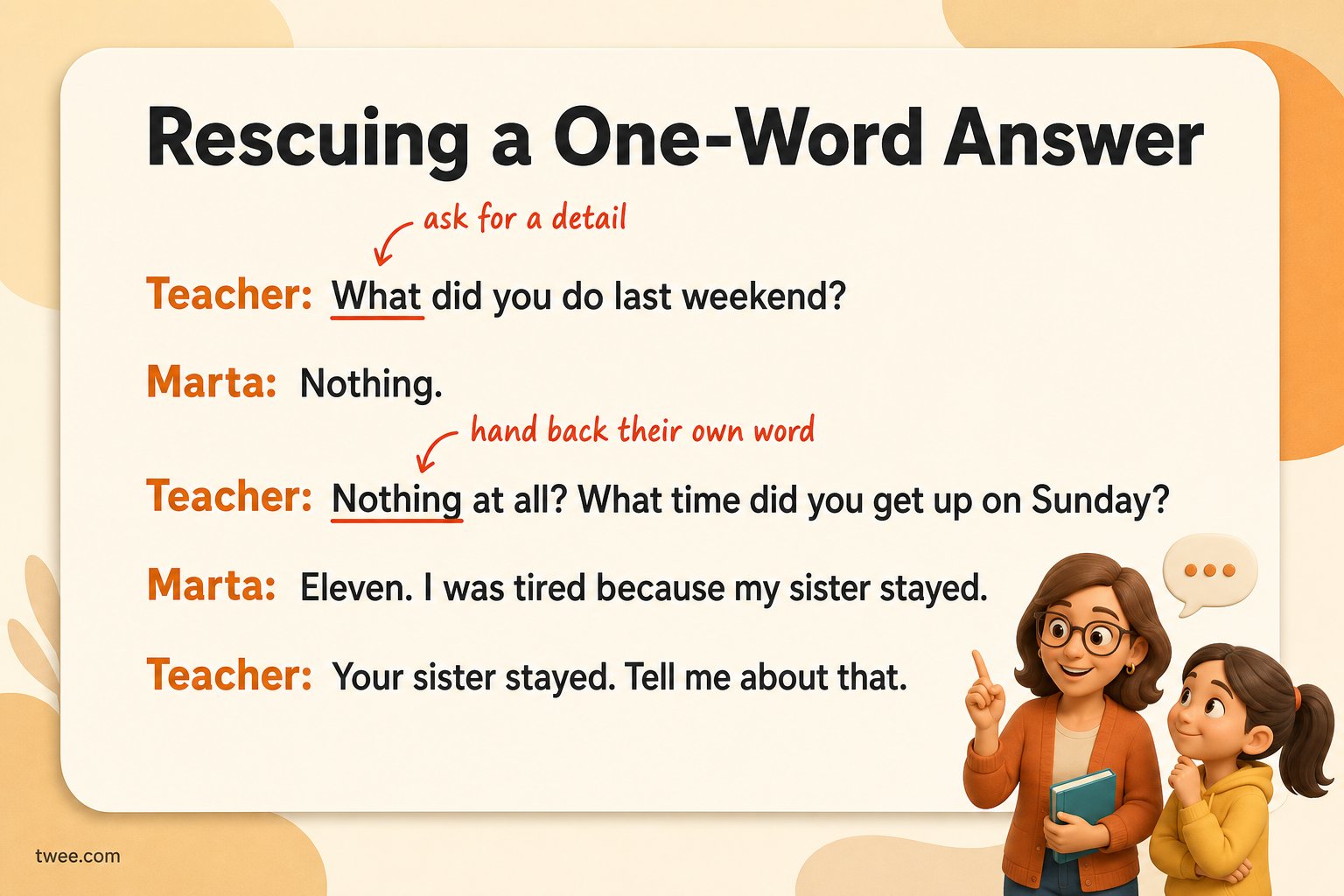
Step three is the one teachers skip, and it is worth seeing in full.
Teacher: "What did you do last weekend?"
Marta: "Nothing."
Teacher: "Nothing at all? What time did you get up on Sunday?"
Marta: "Eleven. I was tired because my sister stayed."
Teacher: "Your sister stayed. Tell me about that."
The move is to ask for a detail rather than repeat the question, then hand the student their own word back. How to increase student talk time has more of these rescues, and they are the difference between a question bank and a conversation.
The questions that die, and what to ask instead
Every list above started as one of these before somebody bolted a constraint onto it.
- "Do you like sports?" → "Which sport would you be worst at?"
- "What do you think about social media?" → "What would you lose if you deleted your accounts tonight?"
- "Tell us about your country." → "What do tourists get wrong about your country?"
- "What are your hobbies?" → "What did you do last Sunday that had no screen in it?"
- "Do you agree that AI is dangerous?" → "Where should AI be banned completely?"
The pattern is the same every time. Swap "do you like" or "what do you think" for a question word plus a limit, and the student has to choose something before they can speak.
Steal these, adapt freely
Print the two sets that match your timetable and keep them with your board pens. Kill any question that dies twice in front of a real class, because a question bank is a living document and yours will not look like mine by December. The rest of the speaking material lives in Twee's ESL speaking lesson plans.
When you need questions on a text your class is already reading, Twee's discussion questions tool generates them at any CEFR level, free to try.
FAQ
What are good ESL conversation questions for adults?
Ask adults about work, money, and changed minds. Try 'What part of your job would you automate tomorrow?', 'What were you certain about at 20 and wrong about now?', or 'Would you take a 20% pay cut for a four-day week?' Skip direct salary questions in one-to-one business classes.
What ESL discussion questions work for beginners?
Keep beginner questions inside present simple and past simple, on everyday subjects. 'What did you eat for breakfast today?', 'Show me a photo on your phone. Who is in it?' and 'Who cooks in your family?' all work at A1. Write a sentence frame on the board first.
What are some ESL discussion questions about AI?
Never ask whether AI is good or bad. Ask students to draw a line: 'Should students use AI for homework? Where exactly is the line?', 'What job will AI never do well?', 'Would you trust an AI doctor with a diagnosis?' Arguing about the line keeps B1 classes talking.
Which conversation questions suit each CEFR level?
Match the question type to the grammar the level already owns. A1 asks about facts right now, A2 about finished events, B1 about experience plus a reason, B2 about trade-offs and hypotheticals, C1 about abstract judgment. In mixed classes, ask the B1 question and give weaker students a frame.
How do you run a conversation lesson with ESL students?
Warm the topic for sixty seconds, ask the question, then give ninety seconds of pair talk before opening it to the class. Chase every one-word answer with a follow-up. Rotate partners and repeat the same question. Save two minutes at the end for unattributed error correction.
