
The best first day of school activities do two jobs at once: they get students talking, and they quietly tell you everything you need to know about the group in front of you. After years in the ESL classroom, I still get that flutter of nerves before a first class — the silence before anyone speaks feels twice as long when it’s in a second language. These 25 back to school activities are the ones that have never let me down, tagged by CEFR level and age group, with free printable worksheets at the end.
In this post:
- Icebreakers and name games
- Getting-to-know-you activities
- Speaking and writing activities for the first English lesson
- 50 icebreaker questions for students, by level
- First week of school: what to do after day one
- Free first-day worksheets and lesson plans
- FAQ
Icebreakers and name games
ESL icebreakers have one extra requirement that most icebreaker games for students don’t: they have to work when learners can’t yet say much. The first day of school icebreakers and games below run on simple language, and the A1-friendly ones need almost none — which makes them perfect ice breakers for kids as well as adults.
1. Adjective Name Game
Level: A2+ · Ages: all — see adaptation · Time: 10 min · Materials: none
- Model it first: introduce yourself with an adjective that starts with the same letter as your name (“I’m Optimistic Olesya”).
- The first student does the same, then repeats yours.
- Each new student adds their name and repeats the chain so far.
- Finish by trying to recite the whole class yourself — let them correct you.
Why it works: names stick because everyone hears each one five or six times, and you get an instant read on vocabulary range.
Adapt it: for kindergarten and elementary students, drop the alliteration and use any adjective plus a gesture. High school students prefer “an adjective that’s actually true about you” — it becomes a personality game instead of a memory game. (If your students need adjective vocabulary first, my adjectives to describe a person lists are sorted by level.)
2. The Name Chain with a Ball
Level: A1+ · Ages: kids, teens · Time: 10 min · Materials: a soft ball
- Stand in a circle. Say a student’s name, then throw them the ball.
- That student names someone else and throws it on.
- After a few minutes, add a second ball to the circle.
- Speed up until it collapses into laughter.
Why it works: it’s pure names and movement — no sentence structures required, so nobody can fail on day one.
Adapt it: for adults, replace the ball with “name + one word you associate with summer” — it keeps the pace but feels less like PE class.
3. Two Truths and a Lie
Level: B1+ · Ages: teens, adults · Time: 15–20 min · Materials: none
- Write three sentences about yourself on the board — two true, one false.
- Students vote on the lie, then you reveal it.
- Students write their own three sentences (give 3–4 minutes).
- In small groups, they read them out and interrogate each other before voting.
Why it works: the interrogation stage is where the real speaking happens — students ask follow-up questions because they genuinely want to catch the liar.
Adapt it: for A2, provide sentence frames (“I have…”, “I have been to…”, “I can…”). For advanced groups, ban “safe” facts — every sentence must be surprising.
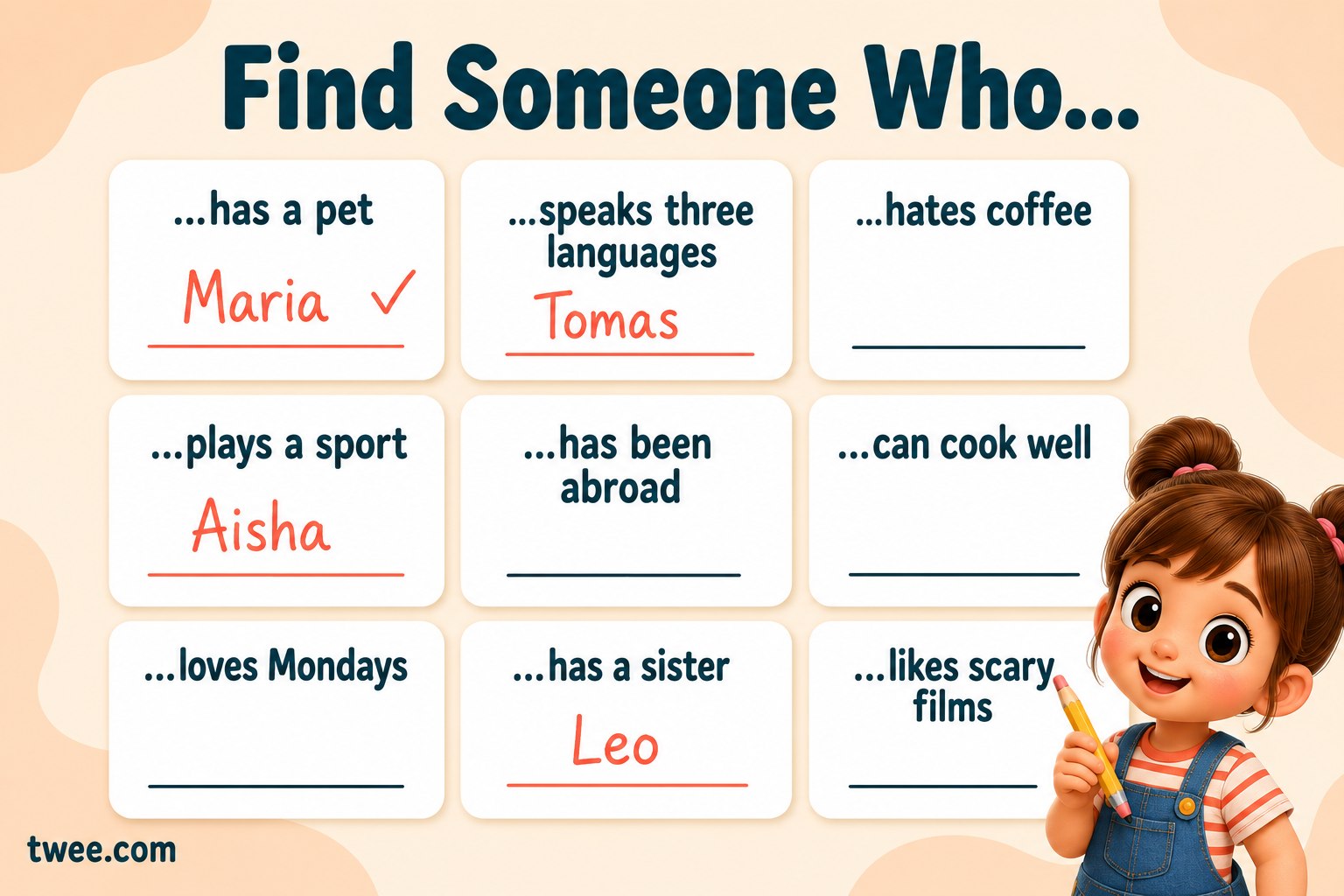
4. Find Someone Who…
Level: A2–B1 · Ages: all — see adaptation · Time: 15 min · Materials: one grid handout per student
- Hand out a grid of prompts: “Find someone who… has a pet / speaks three languages / hates coffee.”
- Students mill around asking full questions (“Do you have a pet?”) — one name per square.
- First to fill a line (or the full card) wins.
- Debrief as a class: “Who has a pet? Tell us about it.”
Why it works: it forces ten short conversations in ten minutes, and structurally it’s just yes/no questions — the first grammar most students actually own.
Adapt it: for kindergarten, use pictures instead of sentences. For adults, write prompts worth discussing afterwards (“has changed careers”, “learned English for work”) — the debrief becomes the main course.
Make it in 2 minutes with Twee: generate level-appropriate prompt sentences with Sentences with Vocabulary and paste them straight into your grid.
5. Take What You Need
Level: A2+ · Ages: teens, adults · Time: 15 min · Materials: a roll of paper squares, sticky notes, or wrapped sweets
- Pass around the sticky notes (or sweets) and say only: “Take as many as you need.” Don’t explain.
- Once everyone has taken some, reveal the rule: one fact about yourself per item taken.
- Go around the room; students who grabbed a handful groan, everyone else laughs.
Why it works: the surprise reversal produces genuine emotion in the first ten minutes of class — and genuine emotion is what makes people forget they’re nervous about speaking.
Adapt it: cap it at five for lower levels, and let A2 students use single words or phrases (“football”, “two brothers”) instead of full sentences.
6. Snowball Fight
Level: A2+ · Ages: kids, teens · Time: 15 min · Materials: paper
- Each student writes three facts about themselves on a sheet of paper — no names.
- Everyone crumples their paper into a “snowball”.
- Thirty seconds of snowball fight.
- Each student picks up a snowball, reads it aloud, and the class guesses whose it is.
Why it works: the chaos is the point — teenagers who would rather die than introduce themselves will happily read a stranger’s crumpled paper.
Adapt it: middle school students especially love this one — expect demands for a second round. Adults will do it too (I promise), but frame it as “anonymous fact exchange” and skip the throwing if the room reads formal — pass the balls around a circle instead.
Getting-to-know-you activities
Getting to know you activities go one layer deeper than icebreakers: the goal is real information exchange, not just breaking silence. These are the first day of class activities where you start learning who your students are — and they start becoming a group.
7. This or That Corners
Level: A1+ · Ages: all · Time: 10 min · Materials: none
- Label one wall “A” and the opposite wall “B”.
- Call out choices: “Tea or coffee? Summer or winter? Cats or dogs?”
- Students walk to their answer, then tell a neighbour why (one word is fine at A1).
- Pull out interesting splits: “Only two people chose winter — defend yourselves!”
Why it works: absolute beginners can participate fully with their feet before they can with their mouths. It’s my go-to when A1 adults freeze — nobody can give a wrong answer by standing somewhere.
Adapt it: teens like harder dilemmas (“famous or rich?”); with adults I sneak in course-relevant splits (“grammar or conversation?”) and use the results to plan.
8. The Map Game
Level: A2+ · Ages: teens, adults · Time: 15 min · Materials: a world map (projected is fine)
- Each student marks or points to three places: where they were born, a place they love, a place they want to visit.
- They explain each in one or two sentences.
- Classmates who share a connection to any place raise a hand and add their story.
Why it works: in a multilingual or mixed-background group, this instantly surfaces the class’s shared geography — and “I want to visit Japan too!” is how strangers become classmates.
Adapt it: for one-country groups, use a national or city map. For B2+, ban naming the place — students describe it and the class guesses.
9. Three Objects
Level: A2+ · Ages: teens, adults · Time: 15–20 min · Materials: students’ own belongings or phones
- Students choose three things from their bag or three photos from their phone that “explain” them.
- In pairs, they present their objects; partners must ask at least two follow-up questions each.
- Each student then introduces their partner to the class using one of the objects.
Why it works: objects carry the conversation, so students talk longer and more naturally than in a bare “introduce yourself” round.
Adapt it: for kids, make it homework the day before (“bring one thing you love”). For business English adults, “three apps you can’t work without” lands perfectly.
10. Interview and Introduce
Level: A2–B1 · Ages: all · Time: 20 min · Materials: question list on the board
- Pair students up and put 5–6 interview questions on the board.
- Partners interview each other and take short notes (5 minutes each way).
- Each student introduces their partner — not themselves — to the class.
Why it works: introducing someone else removes the self-consciousness of self-introduction and secretly drills third-person forms (“she works”, “he has”) — the exact grammar A2 students bend on day one.
Adapt it: pull your questions from the 50 icebreaker questions below, matched to your class level.
Make it in 2 minutes with Twee: Dialogue Creator will generate a model interview dialogue at your students’ exact level to show before they start.
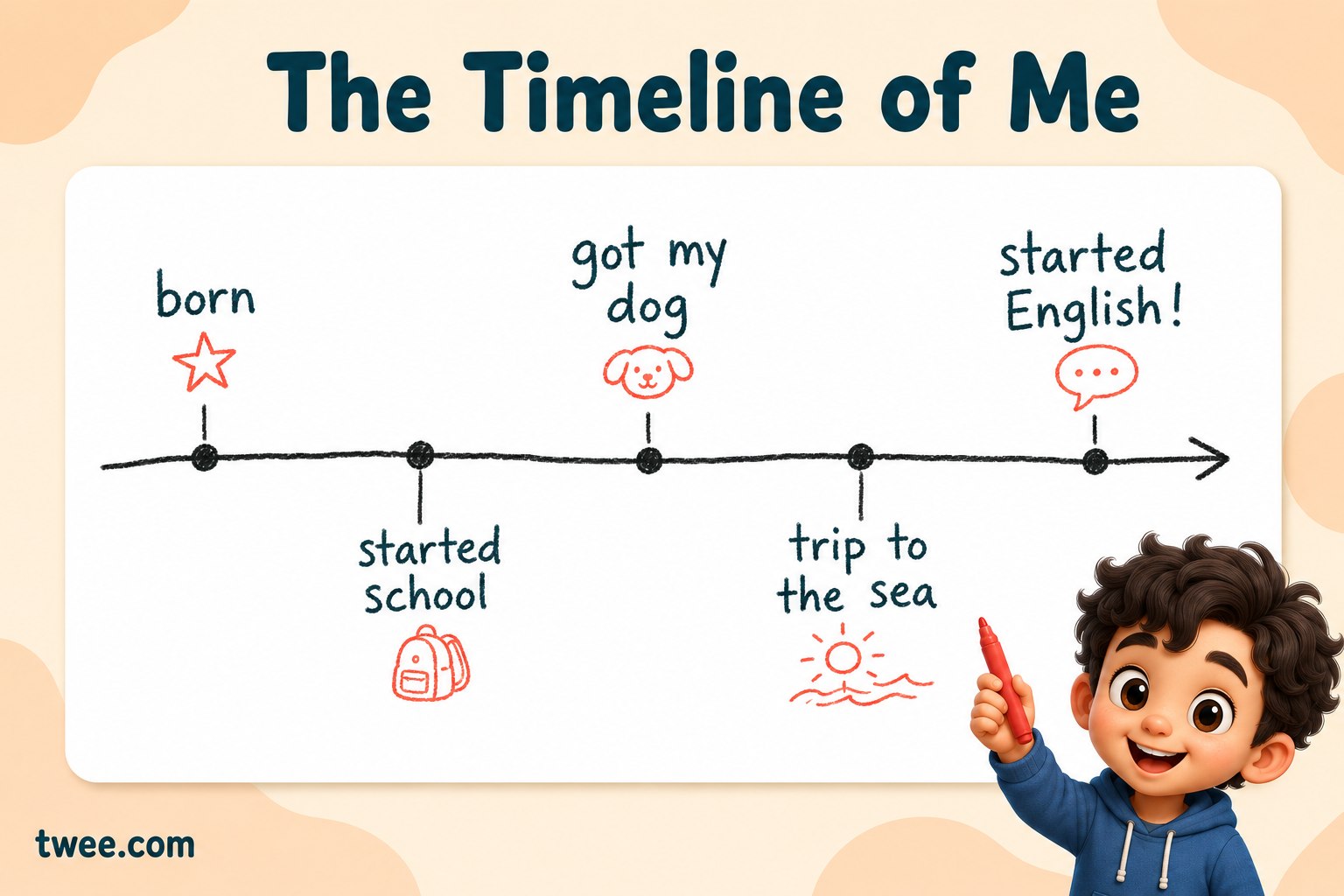
11. The Timeline of Me
Level: B1+ · Ages: teens, adults · Time: 20 min · Materials: paper
- Students draw a horizontal line and mark 4–5 key moments of their life (real or including one invention, if you want a guessing element).
- In small groups, they narrate their timelines.
- Listeners ask one question per moment.
Why it works: it’s a natural past-tense diagnostic disguised as a personal story — by the end you’ll know exactly who controls past simple and who avoids it.
Adapt it: teens can do “timeline of my year” instead of their whole life. For C1 adults, require one moment described with a narrative tense other than past simple.
12. Guess the Teacher
Level: A2+ · Ages: all · Time: 10–15 min · Materials: a short true/false quiz about you
- Put 6–8 statements about yourself on the board (“I have lived in three countries”, “I hate chocolate”).
- In pairs, students mark each true or false.
- Reveal the answers with the stories behind them.
- Flip it: students may ask you three more questions — anything reasonable goes.
Why it works: students are burningly curious about a new teacher, and letting them investigate you first makes it feel fair when you spend the rest of the course asking about them. This one saved my very first class as a nervous new teacher — it buys you ten minutes where curiosity outweighs shyness, including yours.
Adapt it: with kids, use pictures for some statements. With adults, include one professional fact and one silly one — the contrast humanises you fastest.
Speaking and writing activities for the first English lesson
If you teach adults, the first English lesson carries extra weight: your students chose to be there, often after a long day of work, and they’re asking themselves one question — “was this a good decision?” These first day lesson ideas answer it, and double as diagnostics.
13. Why English? Goal Speed-Dating
Level: B1+ · Ages: adults · Time: 20 min · Materials: none
- Write three questions on the board: “Why are you learning English? Where will you use it in one year? What has stopped you before?”
- Students pair up and discuss for 3 minutes, then rotate to a new partner.
- After three rotations, collect goals on the board.
- Keep the board photo — it’s your syllabus compass and your end-of-course evidence.
Why it works: adults commit to a course when they hear their own reasons out loud, and hearing everyone else’s (“me too — presentations terrify me”) builds the group faster than any game.
Adapt it: at A2, simplify to “Why English? What do you like? What is difficult?” and provide sentence starters.
14. My English History
Level: B1+ · Ages: teens, adults · Time: 20 min · Materials: none
- Students tell their partner the story of their English so far: first lesson ever, best teacher, worst moment, proudest moment.
- Partners report one highlight to the class.
- Optional written follow-up: a short paragraph, “My history with English” — your first writing sample of the course.
Why it works: every learner has scar tissue and victories; naming them tells you what this group needs from you emotionally, not just linguistically.
Adapt it: for teens, reframe as “English and me: the honest version” and let them include complaints — you’ll learn more from those than from the compliments.
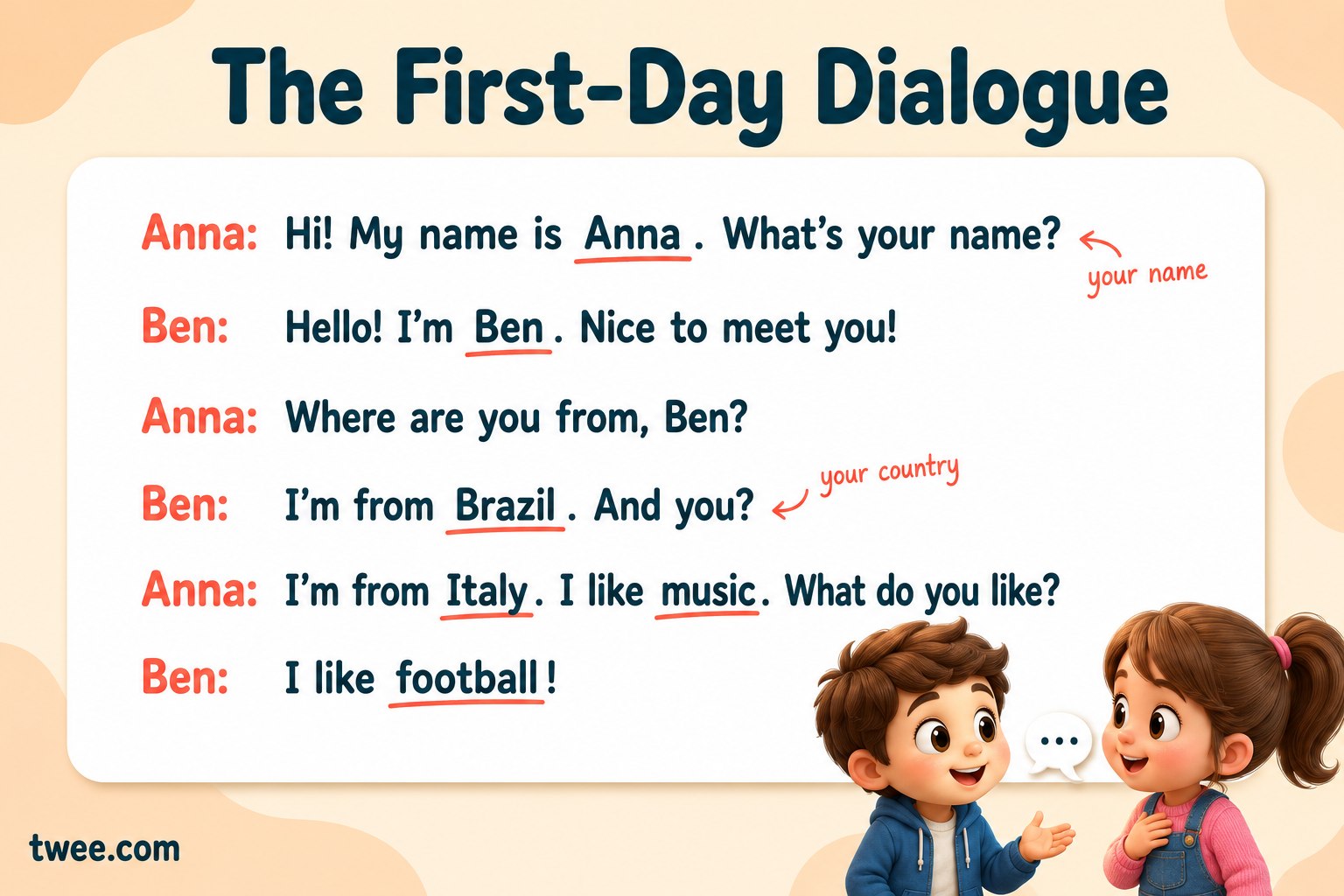
15. The First-Day Dialogue
Level: A1–A2 · Ages: all · Time: 20 min · Materials: a printed model dialogue
- Hand out a short model dialogue of two people meeting for the first time.
- Drill it in pairs, swapping roles.
- Students replace the underlined words with their own information.
- Confident pairs perform; everyone else performs to another pair.
Why it works: at A1, improvising is terrifying but substituting is achievable — students leave the first lesson having genuinely introduced themselves in English, which at this level feels like magic.
Make it in 2 minutes with Twee: Dialogue Creator generates the model dialogue on any topic at exactly A1 — write in the names of your real students for instant engagement.
16. The Class Contract
Level: A2+ · Ages: all — see adaptation · Time: 15–20 min · Materials: poster paper or a shared doc
- In groups, students draft 3–4 rules for the course — in English, phrased positively (“We speak English first” beats “No phones”).
- Groups present; the class votes the best ones onto a single contract.
- Everyone signs it, including you. Display it.
Why it works: rules students wrote are rules students police themselves — and “should/must/let’s” gets a real-life workout.
Adapt it: kindergarten versions are three picture rules. Adult versions work best framed as “what do we all promise each other?” — including promises you make to them.
17. One Sentence, Then a Paragraph
Level: A1+ · Ages: all · Time: 15 min · Materials: paper or notebooks
- Every student writes exactly one sentence introducing themselves.
- Collect, shuffle, read a few aloud — the class guesses the writer.
- Then ask for a paragraph version: “Same sentence, plus three more.”
Why it works: it’s a writing diagnostic that doesn’t feel like a test — and comparing the single sentence to the paragraph shows you who can extend ideas and who hits a wall after “My name is…”.
Adapt it: set the paragraph as the first homework for time-poor adult groups; you’ll start lesson two already knowing everyone’s written level.
18. The Question Box
Level: A2+ · Ages: teens, adults · Time: 10 min (then ongoing) · Materials: a box or envelope
- Every student writes one anonymous question — about you, the course, English, anything.
- Draw and answer a few on the spot; keep the rest.
- Open every following lesson by answering one question from the box.
Why it works: anonymity surfaces the real questions (“Will grammar be on a test?” “Is my accent bad?”) that no one asks aloud on day one — and answering one per lesson becomes a ritual students genuinely look forward to.
Adapt it: for B2+, make it a speaking activity instead: draw a question, and a random student answers it.
19. Letter to My Future Self
Level: B1+ · Ages: teens, adults · Time: 20 min · Materials: paper and envelopes
- Students write a short letter to themselves, to be opened in the final lesson: current level, goals, a prediction, a promise.
- Seal the envelopes; you keep them (unread).
- On the last day of the course, return them. Bring tissues — I’m only half joking.
Why it works: it makes progress visible across the whole course, and the future tenses come out naturally because the task genuinely requires them.
Adapt it: A2 students can write a list instead of a letter (“Now I can… / In June I will…”).
50 icebreaker questions for students, by level
Steal these icebreaker questions for students for any activity above — interviews, speed-dating rotations, the question box. They’re grouped by CEFR level, so match them to your class (or mix levels to stretch stronger students).
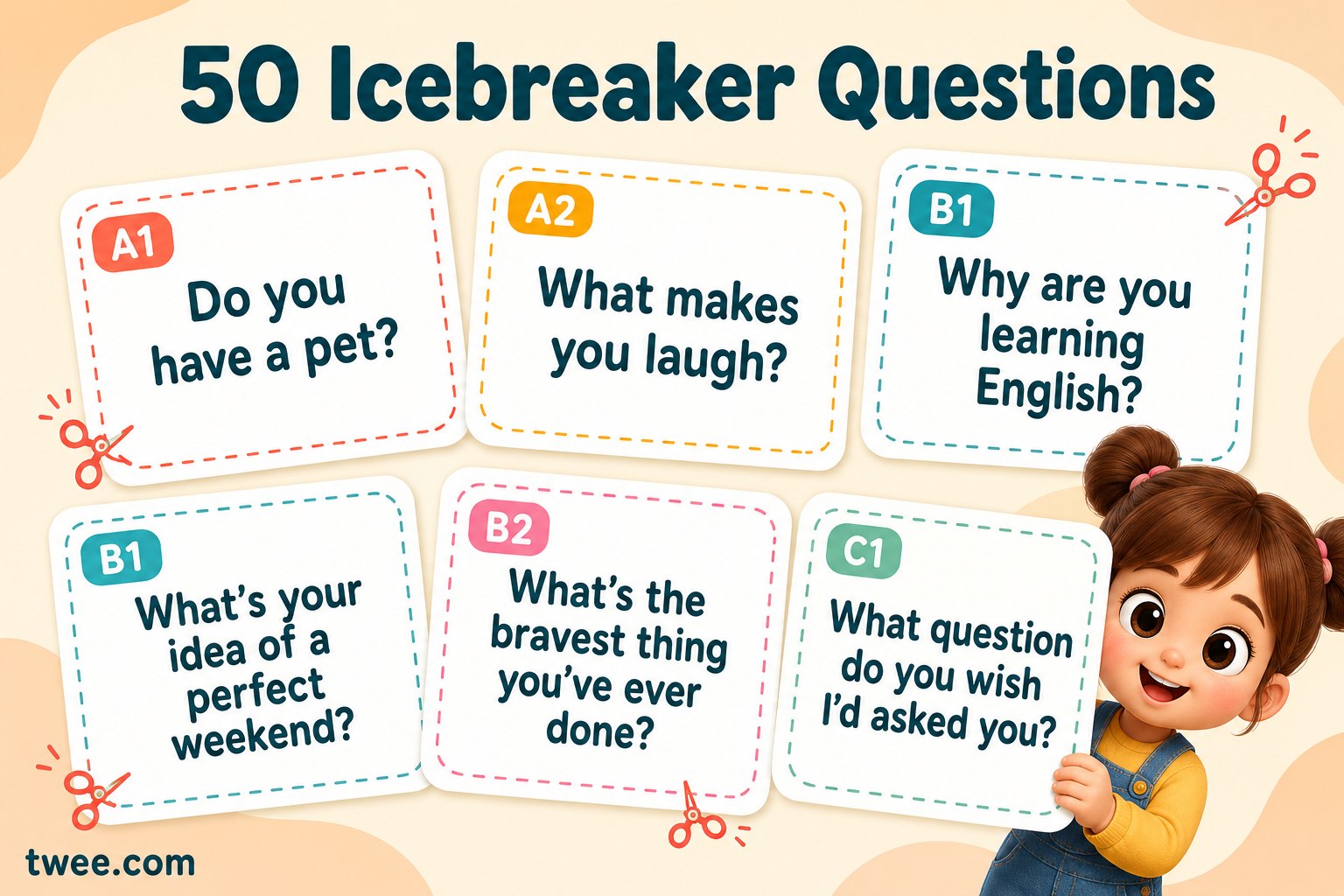
A1 — beginner
- What’s your name?
- Where are you from?
- How old are you? (kids/teens only — skip with adults!)
- Do you have brothers or sisters?
- Do you have a pet?
- What’s your favourite food?
- What’s your favourite colour?
- Do you like music? What kind?
- What day do you like most?
- Cats or dogs?
A2 — elementary
- What do you do (job or school)?
- What do you do at the weekend?
- What’s your favourite film or series?
- What food can you cook?
- Where did you go on your last holiday?
- What sports do you play or watch?
- What’s your favourite app?
- Who do you live with?
- What makes you laugh?
- What did you do yesterday evening?
B1 — intermediate
- Why are you learning English?
- What’s the best place you’ve ever visited?
- What are you really good at?
- What’s something you want to learn (besides English)?
- What was your favourite subject at school?
- If you could have dinner with anyone, who would it be?
- What’s a film everyone loves but you don’t?
- What’s your idea of a perfect weekend?
- What’s the most useful thing you own?
- What job did you want as a child?
B2 — upper-intermediate
- What’s a small thing that instantly improves your day?
- What’s the best piece of advice you’ve ever received?
- If you could live in another country for a year, where and why?
- What’s something you’ve changed your mind about?
- What skill do you think everyone should learn?
- What’s a tradition from your culture you’d share with the world?
- What would you do with an extra two hours every day?
- What’s the bravest thing you’ve ever done?
- Which historical period would you visit?
- What’s a popular opinion you secretly disagree with?
C1+ — advanced
- What’s a belief you hold that most people around you don’t?
- If your life had chapters, what would this one be called?
- What’s something your generation understands that others don’t?
- What’s the difference between being smart and being wise?
- What problem do you wish more people took seriously?
- What compliment do you wish you received more often?
- How has learning languages changed the way you think?
- What’s a risk worth taking that most people avoid?
- If you wrote a book, what would it be about?
- What question do you wish I’d asked you?
First week of school: what to do after day one
Day one breaks the ice; the first week of school activities below turn a room of strangers into a class with habits. This is where most back-to-school plans go quiet — and where the real work starts.
20. The Vocabulary of Us
Level: A2+ · Ages: all · Time: 15 min (day two) · Materials: board
- Collect all the interesting words that came up during day one’s introductions (“nephew”, “engineer”, “hiking”).
- Build a class word bank: “the vocabulary of us”.
- Review it as a matching warm-up in lesson two — words and definitions, or words and classmates.
Why it works: vocabulary that came from students’ own lives gets remembered at a rate coursebook lists can only dream of.
Make it in 2 minutes with Twee: paste your word list into Word–Definition Matching and the warm-up handout writes itself.
21. Classroom Language Survival Kit
Level: A1–A2 · Ages: all · Time: 20 min · Materials: gap-fill handout
- Teach the ten phrases students will need all course: “Can you repeat that?”, “What does ___ mean?”, “How do you say ___ in English?”
- Practise with a gap-fill, then drill in pairs with real gaps (“How do you say [word from their language]?”).
- Poster the phrases on the wall — then insist on them all course.
Why it works: a beginner who can ask for help in English stays in English; one who can’t switches to their first language and stays there.
Make it in 2 minutes with Twee: Fill in the Gap turns your ten phrases into the practice handout instantly.
22. The Day-Two Memory Quiz
Level: A2+ · Ages: all · Time: 10 min · Materials: none
- Open lesson two with a pop quiz — about each other: “Who has three cats? Who speaks Portuguese?”
- Teams win points for remembered details.
- Wrong answers are fine — they trigger the correction, which is the real review.
Why it works: it signals that people in this class listen to each other, which quietly raises the quality of every pair activity for the rest of the course.
23. Build a Ritual
Level: any · Ages: all · Time: 5–10 min per lesson · Materials: none
- Choose one small opener and repeat it every lesson of week one: a two-minute weekend chat, one question-box question, a word of the day.
- Keep it identical each time — predictability is the feature, not a bug.
Why it works: rituals lower the activation energy of speaking; by Friday, students start the routine before you do, and that’s the first sign of a class that runs itself.
Adapt it: young learners thrive on a physical ritual (song, gesture sequence); adults prefer a conversational one.
24. The First Reading Together
Level: A2+ · Ages: all · Time: 25 min · Materials: one short text
- Later in week one, bring a short text built around the class itself — the countries, jobs and hobbies from day one’s introductions.
- Read, then ask comprehension questions that are really memory questions (“Which student in the text loves hiking — and who is it in our class?”).
- Finish with a discussion question from the text.
Why it works: a reading in which students recognise themselves is read twice as carefully — and it’s your reading-skills diagnostic without a whiff of test anxiety.
Make it in 2 minutes with Twee: feed the class’s own words into Text with Custom Vocabulary and you have a personalised reading at exactly the right level.
25. Team Identity
Level: A2+ · Ages: kids, teens · Time: 15 min · Materials: paper, markers
- Divide the class into the teams you’ll use all term.
- Each team invents a name, a motto and a simple logo — all in English.
- Teams present; the class applauds; the names go on your scoreboard permanently.
Why it works: belonging to a team gives shy students a shield — “Team Thunder answers”, not “Marta answers” — and week one is exactly when that shield matters most.
Adapt it: adult groups don’t need logos, but stable discussion pairs or trios established in week one save you re-negotiating the social map every lesson.
Free first-day worksheets and lesson plans
Everything above is runnable straight from this page, but if you want first day of school worksheets and ready-made lessons you can print on your way to class, these are free:
- Classroom Language (A1+, group) — the Classroom Language Survival Kit from #21 as a complete 45-minute lesson.
- Exploring Your True Self (A2+) — a getting-to-know-you lesson built on personality adjectives; a perfect follow-up to activities 7–12.
- Tips for Small Talk in English (A2, adults) — meeting-people dialogues and conversation topics that pair well with the icebreaker questions above.
And if you’d rather walk in with a complete first English lesson plan, we have two ready-made ones:
- First English Class — complete lesson plan
- Getting to Know Each Other — first English class for pre-intermediate (B1) students
Both are free, CEFR-levelled, and built the way the activities in this post are: everything scripted, nothing left to improvise at 7:55 in the morning.
FAQ
What should I do on the first day of English class?
Three things, in order: learn names (activities 1–2), exchange real information (activities 7–12), and finish with one task that produces actual English — a dialogue, a paragraph, a set of goals (activities 13–19). Resist the urge to start the coursebook; the group you build on day one determines how well every future lesson lands.
How do I break the ice with beginner students who won’t speak?
Start with activities that don’t require speech at all — This or That Corners (#7) lets A1 students answer with their feet, and the First-Day Dialogue (#15) gives them exact words instead of asking them to improvise. In my experience with adult beginners, silence is almost never unwillingness — it’s fear of being wrong, and it dissolves the moment a task makes a wrong answer impossible.
What are good first day of school activities for adults?
Adults want to know two things on day one: “is this course worth my time?” and “will I be embarrassed here?” Goal Speed-Dating (#13), My English History (#14) and Guess the Teacher (#12) answer both — they treat learners as interesting adults with reasons and histories, not as students to be processed. Skip anything that feels like a children’s party game unless you frame it with a wink.
How long should icebreakers take on the first day?
For a 60-minute lesson: one name game (10 minutes), one getting-to-know-you activity (15–20 minutes), one language-producing task (20 minutes), and save five minutes to preview the course. A first lesson that is all icebreakers sends the wrong message — students should leave feeling they already learned something.
