
Your class fills in a singular and plural nouns worksheet. Every answer is right. Ten minutes later, a student says, "I have two brother and three childs." The worksheet worked on paper and nowhere else.
This post gives you the plural rules in the order students can actually use them, plus six activities that move those rules from the page into speech. Each one has a level, a time, and the prep it needs. Activity 4 is the sleeper hit, and it uses nothing but a bag of classroom junk.
The short answer: a good singular and plural nouns worksheet mixes regular plurals (-s, -es, -ies) with a few irregular ones (child → children) and a few nouns with no plural at all (advice, homework). Then it makes students say the words out loud and use them in sentences, not only fill in blanks.
Singular and plural noun rules, in the order students need them
Most worksheets list every rule at once. That's the textbook order, not the learning order.
Teach them in this sequence instead. Rules 1 to 3 cover most of the nouns a beginner meets in a normal week. The rest can wait a lesson or two.
| Rule | Example | Watch out for |
|---|---|---|
| 1. Most nouns: add -s | book → books, pen → pens | The -s sounds different in "cats," "dogs," and "buses" |
| 2. Ends in s, ss, sh, ch, x, z: add -es | box → boxes, watch → watches | "Stomach" ends in ch but takes -s |
| 3. Consonant + y: change y to -ies | city → cities, baby → babies | Vowel + y keeps the y: day → days, toy → toys |
| 4. Ends in f or fe: often -ves | knife → knives, leaf → leaves | roof → roofs, chef → chefs |
| 5. Ends in o: -s or -es | tomato → tomatoes, potato → potatoes | photo → photos, piano → pianos |
| 6. Irregular: new word | child → children, foot → feet | Students add -s anyway: "childs," "foots" |
| 7. No change | sheep → sheep, fish → fish | "Two sheeps" will appear. Smile and recast. |
Here's the catch with rule 4. The f rule has so many exceptions that I teach it as a short word list, not a rule.
Students memorize knife, wife, leaf, half, and life. Everything else gets -s until proven guilty.
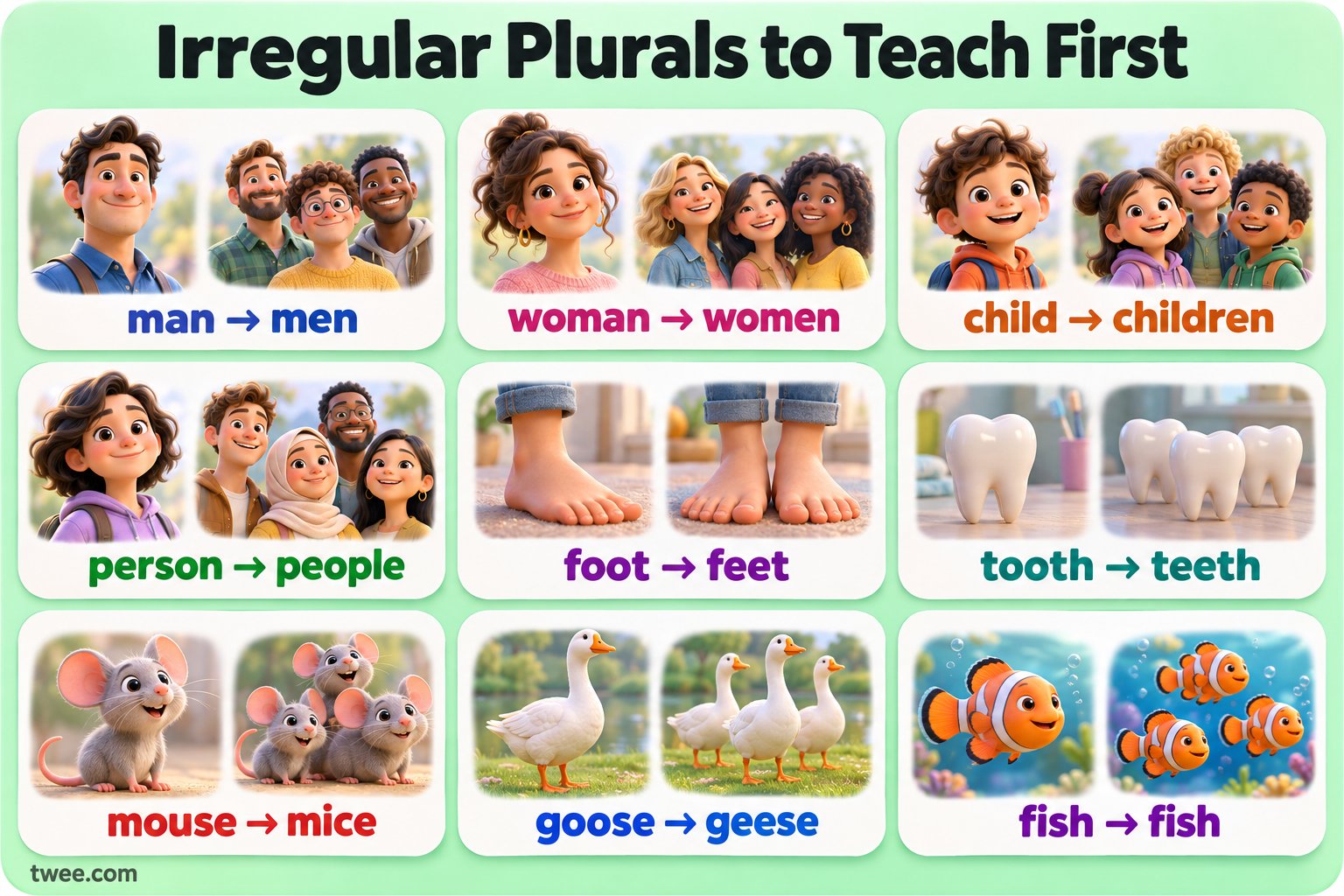
Irregular plurals work the same way. A1 and A2 students truly need only nine: man → men, woman → women, child → children, person → people, foot → feet, tooth → teeth, mouse → mice, goose → geese, and fish → fish. Give them the list and drill it.
You'll find more practice in this irregular plural nouns worksheet.
Activity 1: the /s/, /z/, /ɪz/ sound sort
Worksheets teach spelling. They skip the sound, and the sound is where students stay stuck for years.
Level: A1+ · Time: 10 min · Prep: 15 plural nouns on the board
- Draw three columns: /s/ (cats), /z/ (dogs), /ɪz/ (buses).
- Say each plural on the board twice, clearly.
- Students hold up one, two, or three fingers to show the column.
- Sort the words together, then ask pairs to find the pattern.
Most pairs find it in about three minutes.
Words that end in a hissing sound (s, sh, ch, x, z) get an extra syllable. That's /ɪz/. The other two columns are close, and honestly, nobody fails a test over /s/ versus /z/.
The twist: put "houses" on the list. The singular ends in /s/, but the plural sounds like "how-ziz." Even B2 students get this one wrong, and they love catching it.
Activity 2: error auction
Students are much better at spotting mistakes when they have to bet on them.
Level: A2+ · Time: 15 min · Prep: 10 sentences, about half with a plural error
- Give each team 100 fake dollars.
- Show one sentence at a time, such as "My feets hurt after the long walk."
- Teams bet 10 to 50 dollars that the sentence is correct.
- Reveal the answer. Correct sentences pay double. Wrong ones lose the bet.
Mix the errors on purpose. Put in "two childrens," "many informations," and "three boxs." Then add one correct sentence that looks wrong, like "The sheep are in the field."
That last one is the expensive lesson. Teams always bet against it.
The twist: make the winning team correct the sentences they lost money on. You get the correction stage for free. Nobody wants to lose twice.
Activity 3: the shopping list role-play
Shopping is where plurals live in real life. Every line has a number and a noun.
Level: A1–A2 · Time: 15 min · Prep: one short model dialogue
- Show the model dialogue below and read it with a strong student.
- Pairs write a list of six items, at least two of them irregular or -es nouns.
- Student A is the shop assistant. Student B orders from the list.
- Swap roles with a new list.
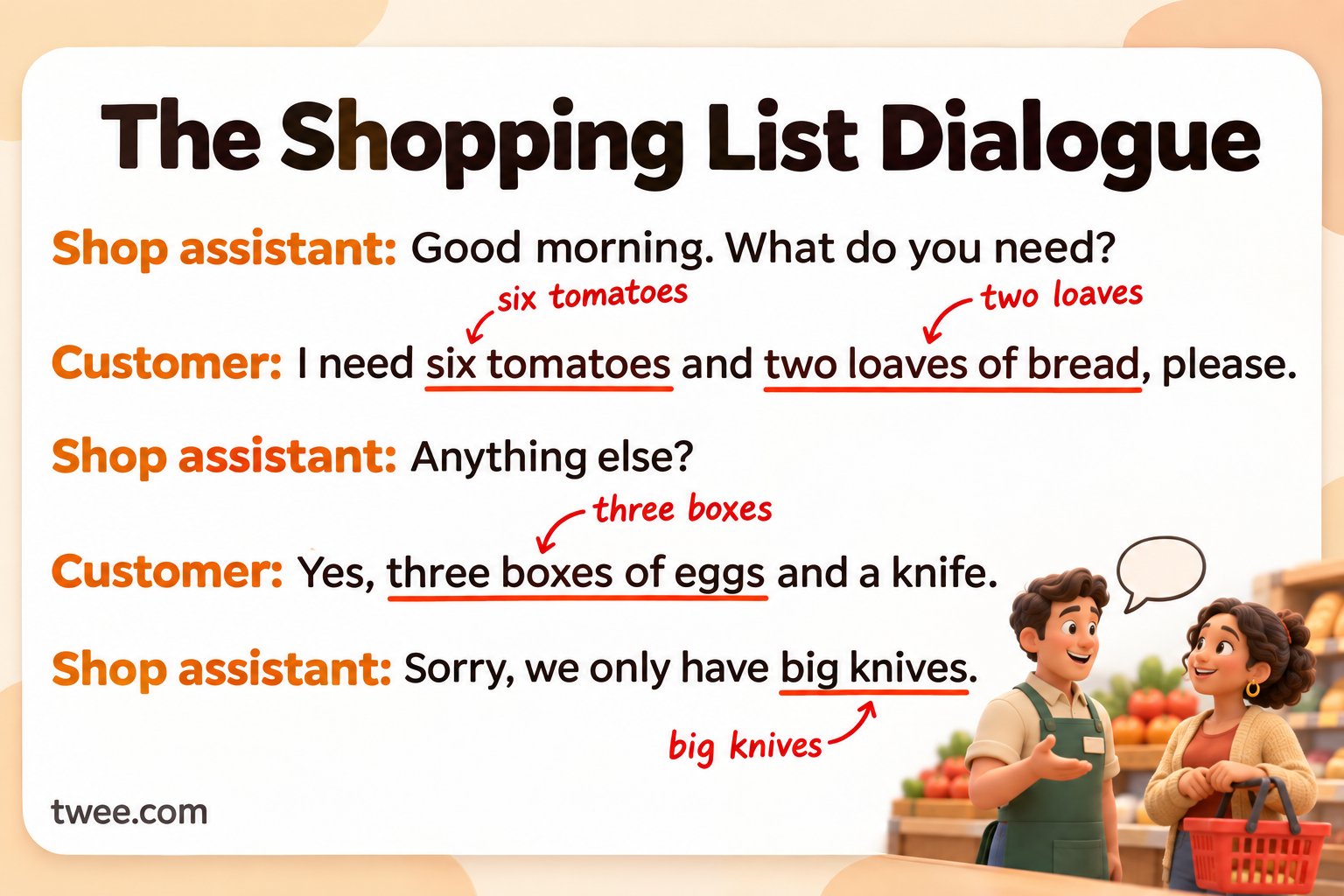
Here is the model I use with A2 adults, and it works just as well with eleven-year-olds:
Shop assistant: "Good morning. What do you need?"
Customer: "I need six tomatoes and two loaves of bread, please."
Shop assistant: "Anything else?"
Customer: "Yes, three boxes of eggs and a knife."
Shop assistant: "Sorry, we only have big knives."
If you don't want to write the model yourself, Twee's dialogue creator can do it. Type "A2 shopping dialogue using tomatoes, loaves, boxes and knives" and you get a script in seconds.
The twist: ban the word "some." Students hide behind "some tomato." Without it, they have to choose a number, and the plural follows.
Activity 4: what's missing from the bag?
This is the sleeper hit. It needs zero prep and gets more talk than anything else on this list.
Level: A1+ · Time: 10 min · Prep: a bag of classroom objects
- Put objects on a desk in groups: three pens, two keys, one eraser, four coins, two watches.
- Students look for 30 seconds, then close their eyes.
- Take one or two items away.
- Students say what changed: "There were three pens. Now there are two pens."
The magic is in the sentence frame. Students switch between singular and plural over and over, out loud, with real things in front of them. Last term a shy A1 group of mine played this for twenty minutes and asked for "one more" three times.
The twist: take away the last one of something. Now the answer is "There was one eraser. Now there are no erasers." That "no + plural" pattern surprises students, and it's correct.

Activity 5: build a singular and plural nouns worksheet that sticks
Here's the honest truth about most printable worksheets. They test one rule per section, so students only have to notice the pattern, not think.
Level: any · Time: 20 min to build · Prep: a short text your class already knows
- Take a text from your coursebook or last lesson.
- Blank out 10 to 12 nouns and give the singular in brackets: "Two (child) ____ were playing."
- Mix all the rules in one exercise, not one rule per box.
- Add two nouns with no plural, like "advice" and "furniture," as a trap.
- Finish with three sentences students write about their own life.
Step 5 is the part most worksheets leave out. "I have two sisters and one brother" is a real sentence, so it stays with them. A gap fill doesn't.
You can build the gap fill from any text in about a minute with Twee's fill-in-the-gap tool. If you'd rather print something today, the singular and plural nouns worksheets on Twee already mix the rules. There's a singular and plural nouns worksheet for kids and teens and a singular and plural nouns worksheet for adults.
Activity 6: the nouns that refuse to be plural
Advice, homework, furniture, information, news. These cause more errors at B1 than every irregular plural put together.
Level: A2+ · Time: 10 min · Prep: 12 word cards
- Mix six countable nouns (chair, tip, fact) with their uncountable partners (furniture, advice, information).
- Pairs sort the cards into two piles: "can add -s" and "never add -s."
- Each pair writes one sentence for each uncountable word using "a piece of" or "some."
The pairs are the clever part.
A chair is countable, but furniture is not. A tip is countable, but advice is not. Seeing the two side by side shows students that the idea is the same, only the grammar changes.
The twist: warn them about "news." It ends in -s but takes a singular verb: "The news is good." Students will argue. Let them.
Then move on to countable and uncountable nouns worksheets when the class is ready for the full topic.
Steal these, adapt freely
Start with the sound sort and the bag game this week. Save the auction for a Friday when energy is low. If plurals are going well, "this, that, these, those" is the natural next step, since every one of them changes with the noun.
Want a gap fill from any text in a minute? Try Twee's fill-in-the-gap tool for free.
FAQ
What are the rules for singular and plural nouns?
Most nouns add -s (book → books). Nouns that end in s, sh, ch, x, or z add -es (box → boxes). Consonant + y becomes -ies (city → cities). Some f/fe nouns become -ves (knife → knives). Irregular nouns change form (child → children), some never change (sheep).
What are irregular plural nouns?
Irregular plural nouns don't add -s or -es. They change form instead: man → men, child → children, person → people, foot → feet, tooth → teeth, mouse → mice. Beginners need only about nine of them, so teach them as a short list and drill it.
Which nouns have no plural form?
Uncountable nouns have no plural form: advice, homework, furniture, information, and news. Use "some" or "a piece of" instead ("a piece of advice"). Note that "news" ends in -s but takes a singular verb: "The news is good."
How do you teach singular and plural nouns?
Teach regular -s, -es, and -ies first, since they cover most beginner nouns. Then add a short list of irregular plurals. Practice the three ending sounds (/s/, /z/, /ɪz/), and get students saying plurals out loud in games and role-plays, not only filling in worksheet blanks.
When do you add -s, -es, or -ies to make a noun plural?
Add -s to most nouns (pen → pens). Add -es when the noun ends in s, sh, ch, x, or z (watch → watches). Change y to -ies when a consonant comes before the y (baby → babies). After a vowel, keep the y and add -s (day → days).
