Expressing Preferences (Would Rather, Would Prefer)
ESL Grammar WorksheetsExpressing Preferences (Would Rather, Would Prefer)

Expressing Preferences (Would Rather, Would Prefer)

This B1–B2 grammar worksheet helps adult ESL learners practise expressing preferences using would rather, prefer, would prefer, and would go for. It includes clear explanations, examples, and an individual production task to build confidence in both speaking and writing. Ideal for ESL, EFL, and general English classes, this resource supports communicative learning and real-life language use, making it perfect for lesson planning, revision, and self-study.

Online Interactive
Based on CEFR
Fully Customizable
1

Study this grammar rule.

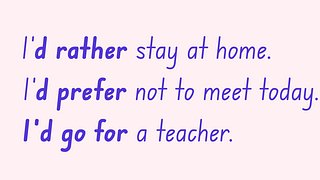
1) Would rather We use "would rather" to talk about specific or hypothetical preferences. Structure: would rather + infinitive (without to) (+ than + infinitive) Examples: I'd rather stay at home. We'd rather stay in tonight than go out. Would you rather live in a city or in the countryside? Negative: would rather + not + infinitive I'd rather not answer that question. Strong preference: would much / far rather I'd much rather go skiing than surfing. I'd far rather cycle than take the underground. 2) Prefer / Would prefer We use 'prefer' and 'would prefer' to talk about preferences. Prefer → general preferences Structure: prefer + noun / -ing + to + noun / -ing Examples: I prefer cats to dogs. He prefers working alone to working with others. Strong preference: much / definitely prefer I definitely prefer cats to dogs. I much prefer playing tennis to watching it. Would prefer → specific or hypothetical situations Structure: would prefer + to + infinitive Examples: I'd prefer to get a takeaway tonight. Would you prefer to live in the Arctic or the Sahara? Negative: would prefer + not + to + infinitive I'd prefer not to meet today. Strong preference: I'd much / definitely prefer to go by train. 3) Would go for (= would choose / prefer) We use 'would go for' to say what we choose. Example: Which would you rather be, a teacher or a doctor? - I'd go for a teacher. This is informal spoken English.
2

Use the correct form of the words in brackets to complete each sentence.

3

Find and correct the mistakes.

4

Rewrite the sentences using the target structures.

5

Write your sentences.

Other worksheets in this category